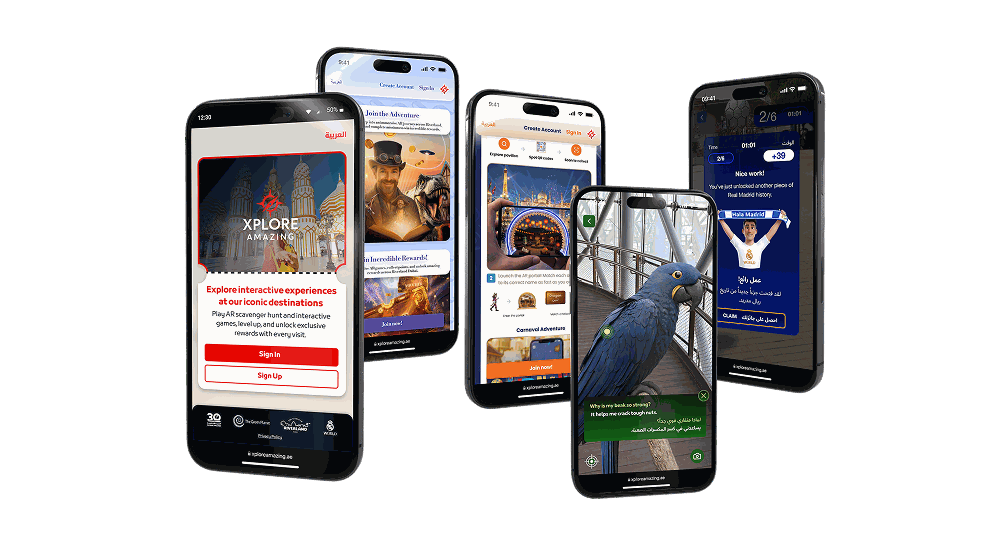
A phygital gamification platform connecting four of Dubai's major leisure destinations through AR missions, XP progression, and cross-park experiences — all from a mobile browser, no app download required.
Xplore Amazing — cross-park gamification ecosystem
Xplore Amazing is a phygital gamification platform built for Dubai Holding Entertainment, connecting Global Village, Riverland Dubai, The Green Planet, and Real Madrid World through a single unified system. Visitors engage in AR-powered missions, earn XP, collect digital artifacts, and track progress across all parks — triggered entirely through QR codes placed at physical touchpoints, with no app download required.
A team of four designers worked across UX, UI, and systems design. My ownership spanned three critical areas: the overall information architecture and feature structure across all five apps, the mid-fidelity framework the design system was built on top of, and full primary ownership of the Real Madrid World module end-to-end.
DHE wanted to transform passive park visits into interactive, narrative-driven digital experiences. The business goals were clear: increase dwell time, drive repeat visitation, and capture first-party behavioral data — all while staying compliant with UAE's PDPL data regulations.
The platform had to work across four very different parks, each with its own identity, audience, and emotional atmosphere, while still feeling like one coherent ecosystem. No native app. Bilingual. Triggered entirely through QR codes placed at physical touchpoints across the venues.
The challenge wasn't building four separate apps — it was building one system that could wear four different identities without losing coherence.
Structural framework for all five apps: top-level navigation model, page taxonomy, and how cross-park features fit within a shared hierarchy.
Component-neutral frames covering core flows across all apps — the handoff specification for the design system build.
End-to-end primary ownership: visual language, UI system, every game mechanic, mini-game, and badge — designed by me.
Flagged a structural flaw in the scoring model before launch, walked the team through the math, and led the redesign to a continuous XP accumulation model.
With four parks and a core platform to design simultaneously, the first challenge was defining what each app actually contained — what features, in what hierarchy, accessible from which surfaces.
I designed the structural framework for all five apps: the top-level navigation model, the page taxonomy (Home, Missions, Leaderboard, Collections, Rewards, Profile), and how features like the virtual passport, cross-park progression, and park-specific rewards fit within that structure. This IA became the shared foundation that all four designers worked within.
The goal was flexibility within consistency — each park needed enough room to express its own personality, but the underlying structure had to be identical so users moving between parks felt at home immediately.
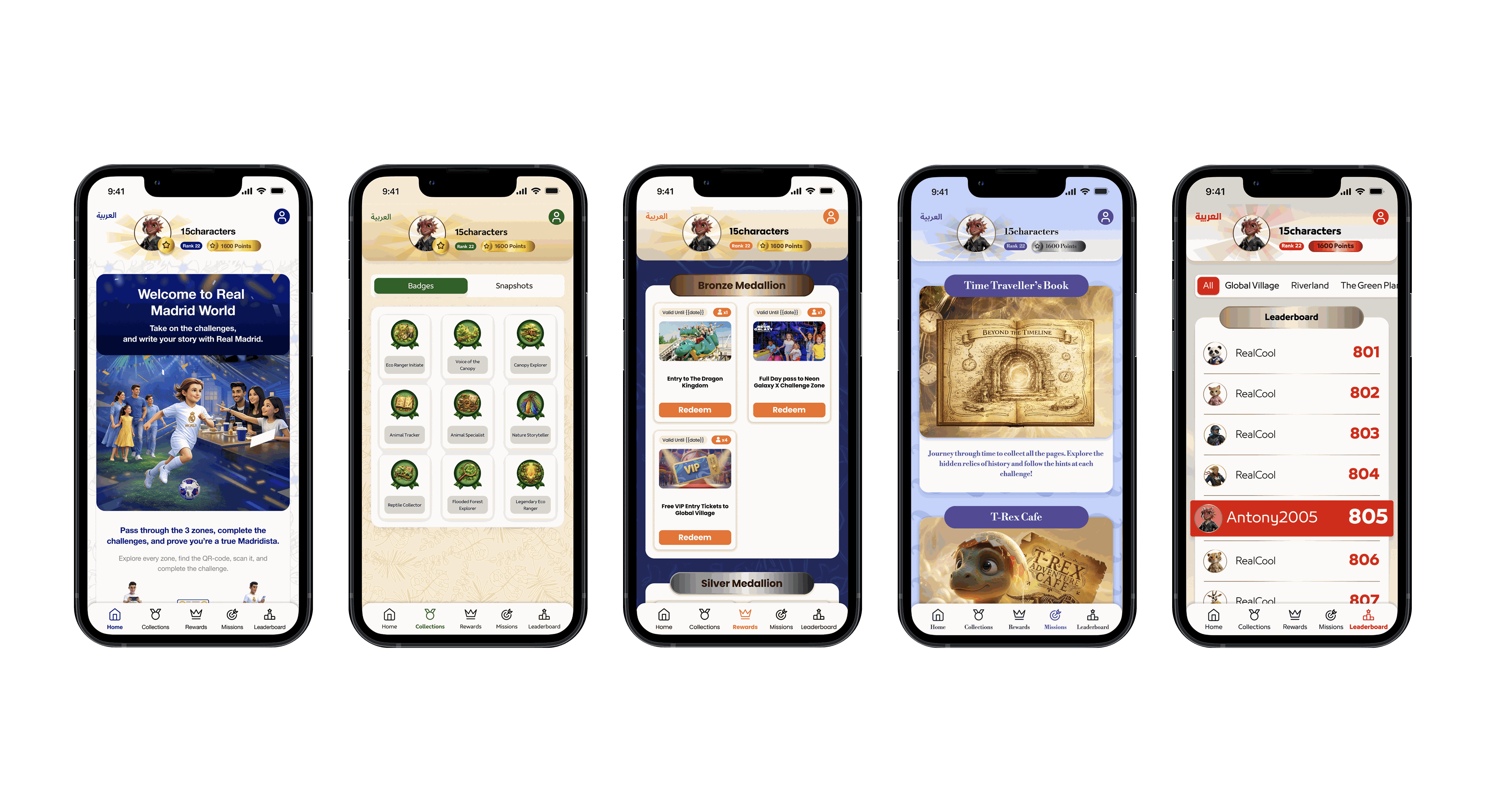
Shared IA — page taxonomy across all five apps
Midway through the project, the team was converging on a discrete 0–100 point scale for the scoring system. On the surface, it seemed reasonable — clean, bounded, easy to understand.
I flagged the problem immediately, drawing on prior experience with gamification systems at scale: in a high-footfall environment like DHE's parks, which collectively draw hundreds of thousands of visitors per season, a discrete 100-point ceiling guarantees massive rank collisions. Thousands of users would share identical scores, making the leaderboard functionally meaningless — and worse, demotivating.
A leaderboard where your rank is tied with 3,000 other people doesn't drive competition — it kills it.
I walked the team through the math and the behavioral implications. The fix was switching to a continuous point accumulation model — where XP accrues incrementally from every micro-interaction, mission step, and AR engagement — so that meaningful rank differentiation was always possible regardless of user volume.
The team aligned after a few sessions and the system was redesigned accordingly. Four months after the first release, the platform had grown to over 13,500 users — a number that would have broken the original scoring model entirely.
My most personally significant ownership on the project was designing for the Real Madrid World app. I was the primary designer on this module end-to-end: visual language, UI system, game mechanics, and interactive experiences.
Having been a Real Madrid fan since adolescence, working directly with the club — attending coordination sessions with Madrid's team to align on brand usage, visual standards, and content direction — was an experience I wasn't expecting to have professionally.
The app leaned hard into the club's visual identity: Helvetica Neue as the type system, a high-contrast editorial aesthetic influenced by the club's official communications, and game elements designed to feel like they belonged in the stadium rather than a generic mobile experience. Every mini-game and badge in the module was designed by me — built to feel like authentic Madrid merchandise rather than generic gamification assets.
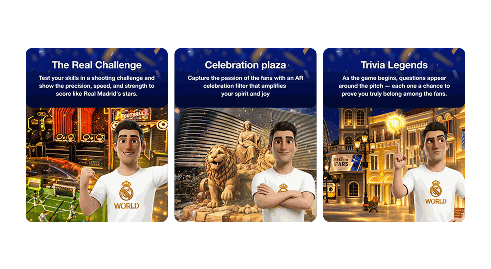
Missions' Cards — stadium aesthetic
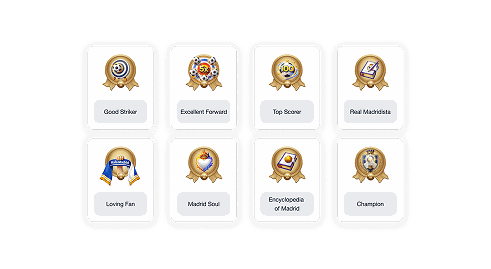
Badge collection — feel like authentic club merchandise
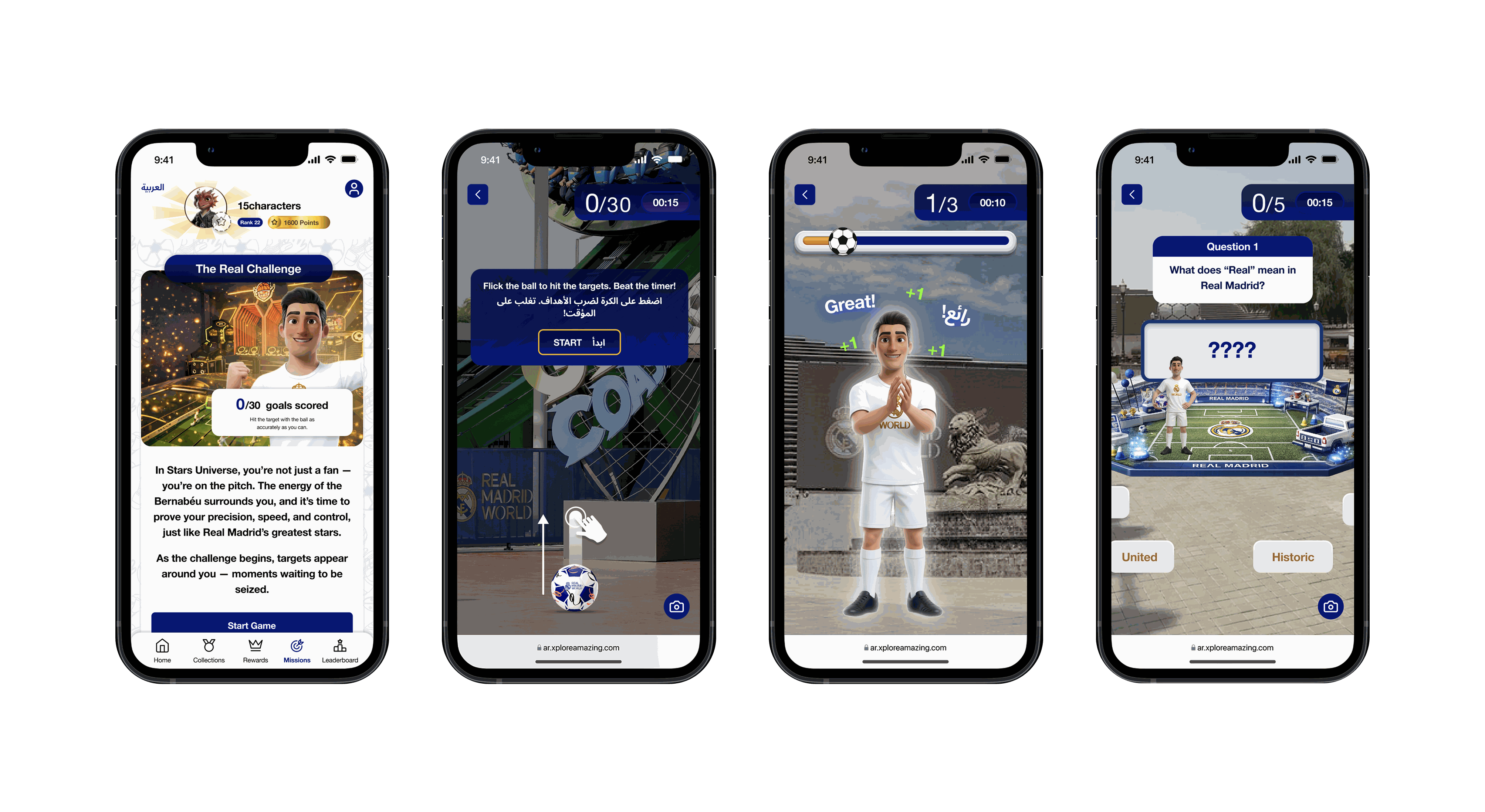
Missions — 3 Zones, 3 Pillars, 3 Games
The five-app ecosystem was structured around a shared progression layer — a core platform hub and four park-specific modules, each with its own visual language while sharing the same underlying IA, point logic, and profile system.
Cross-park progress, virtual passport, rewards catalog, and global leaderboard — the connective layer that turns four park visits into one ongoing narrative.
Multicultural atmosphere, festive tone of voice, high-energy color palette reflecting the park's international character.
Serif-forward editorial aesthetic, exploration and discovery as the emotional register, warm heritage palette.
Custom typeface, organic design language, nature and wonder as the primary emotional register.
High-contrast editorial aesthetic aligned with the club's official communications. Prestigious, athletic, built for fans.
| Park | Typography | Emotional Register |
|---|---|---|
| Global Village | Poppins | Festive, multicultural |
| Riverland Dubai | Libre Bodoni | Heritage, exploration |
| The Green Planet | TGP Sans | Nature, wonder |
| Real Madrid World | Helvetica Neue | Athletic, prestigious |
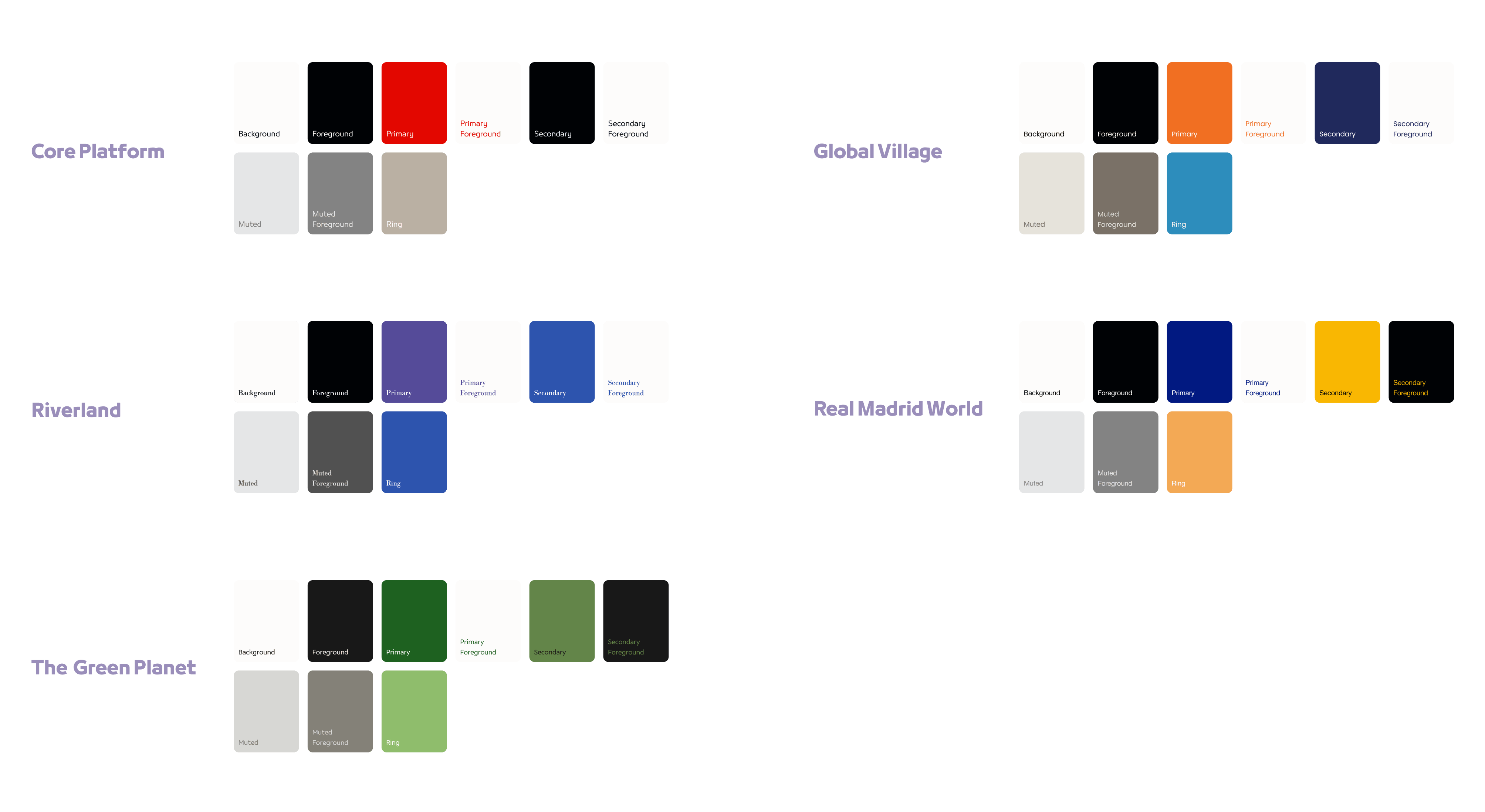
Four distinct visual identities, one shared structural foundation
The platform launched with a sequential, park-by-park rollout — an intentional strategy that allowed for learning and iteration between releases rather than a single high-risk launch.
Four months after the first park went live, the platform had reached 13,500+ users — a result that validated the engagement model and led directly to the decision to scale across additional parks and locations.